


Private telescope evenings · Surrey
Surrey Sky Tales
A real night under the Surrey sky
with a Meade 12" telescope.
Saturn, Jupiter and the Moon, live in the eyepiece. Real objects, a real eyepiece, and someone beside you to show you where to look.
The experience
This isn't just looking at the stars.
We meet after dusk and drive out to a dark spot away from the worst of the light pollution — the kind of place where your eyes slowly adjust and the sky keeps getting deeper the longer you stand there.
I find each object, centre it in the eyepiece, and then tell you exactly what you're looking at: how far away it is, what it's made of, why it looks the way it does. You look. Then we move to the next one.
The evening is deliberately unhurried — allow several hours, and we'll take the time the night deserves.
Look through the telescope
The telescope is the experience.
Meade LX90 12" · Schmidt-Cassegrain on a tracking mount
Not a lecture, not a screen. You stand at the eyepiece and the light reaching your eye has travelled from the object itself — tonight, live, in front of you.
A Meade LX90 12" Schmidt-Cassegrain on a tracking mount, proper eyepieces, and the same setup used to take the astrophotographs on this site.
You don't need to know a thing about aperture or focal length. All that matters is what it does: it finds real objects in the night sky, holds them steady, and puts them in front of your eye.
Everything else on this page — the photographs, the explanations, the scale of things — is there to make that moment richer.
Seeing the difference
What a 12-inch telescope actually resolves.
The 12" Meade LX90 can reveal surprisingly fine detail even at long distances. This daytime example shows a fly on a distant chimney.
What might we see?
It depends on the night.
What we observe depends on the season, the night, the weather and what is above the horizon. No two evenings show the same sky — and that's part of why it's worth doing properly.
The Moon
Crater fields, mountain ranges and long shadows along the terminator. Almost always the biggest surprise of the night.
Planets
Saturn's rings, Jupiter's belts and moons. Bright, sharp and unmistakable — even from less-than-perfect skies.
Star clusters
Loose swarms and tight globular knots of thousands of stars, resolving into pinpoints as your eye adapts.
Nebulae
Clouds of glowing gas, seen as soft grey-green structure through the eyepiece rather than as colour.
Galaxies
Faint patches of light — but light that left another galaxy millions of years before it reached your eye.
Double stars
Pairs that split into two suns at high magnification, sometimes with beautiful contrasting colours.
The Moon & planets
A whole world, one crater at a time.
The Moon rewards patience. Near the terminator — the line between lunar day and night — shadows stretch for miles and craters stand out in relief. Come back an hour later and the light has already changed.
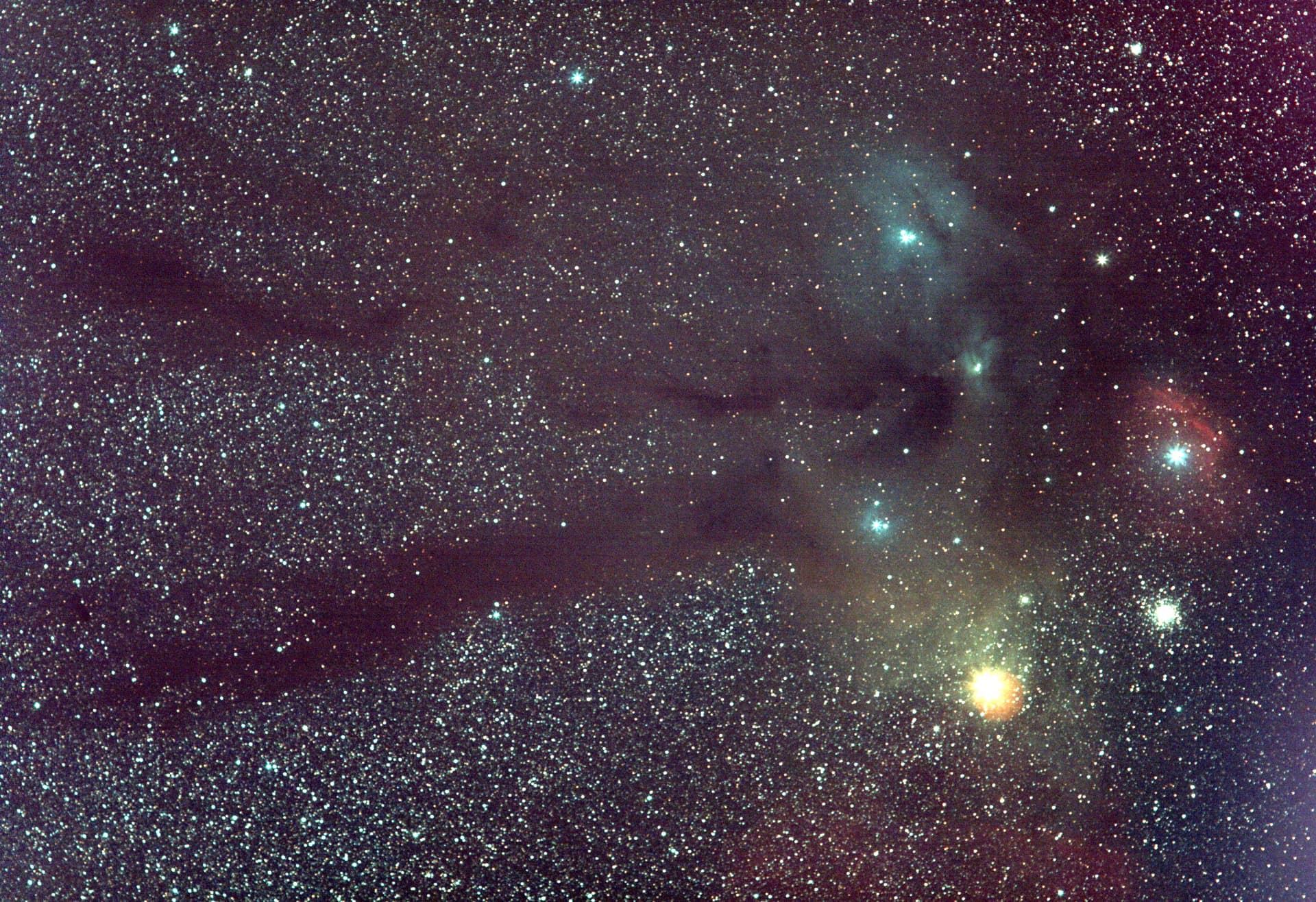
The eye does not see everything. A camera can gather light for minutes at a time; your eye cannot — so the astrophotographs in the gallery, made with a Meade LX90 12" and a Nikon D7000, show more detail and colour than the eyepiece does. Through the telescope the same objects are fainter and softer, and seeing them live is still the better half of the evening.
Planets are bright, and brightness beats darkness. They hold up well even when the sky isn't perfect, and they're the moment most guests step back from the eyepiece and ask to look again. Which planets are on show changes through the year, so nothing is promised in advance — but when Saturn is up, it's the one people remember.
Jupiter
Dark cloud belts, and the four large moons strung out in a line that visibly shifts from night to night.
Through the telescope
Saturn
The rings separate cleanly from the planet. Nobody is quite prepared for it looking that much like the pictures.
Through the telescope
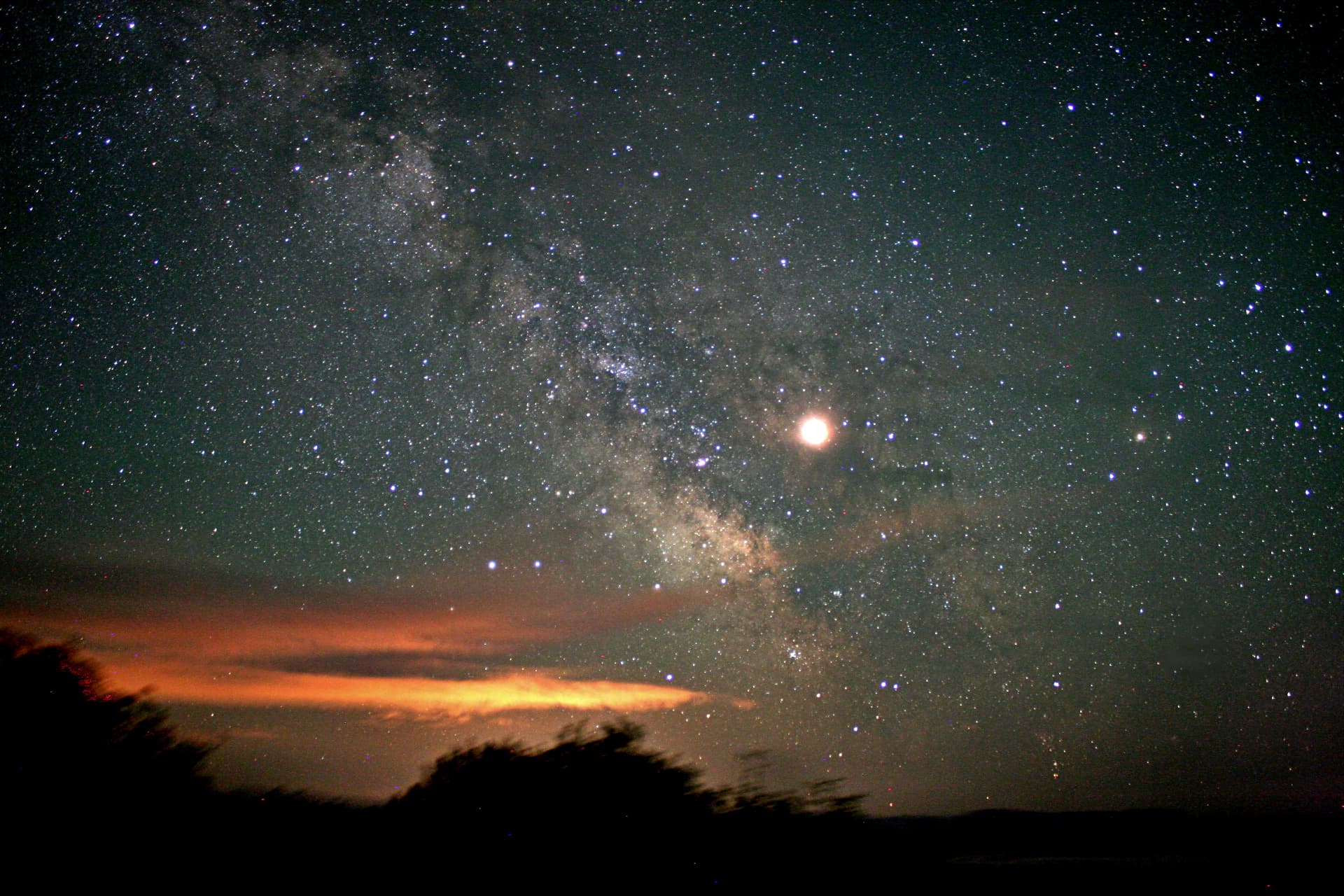
The Milky Way
Under a dark sky, the Milky Way stops being a photograph.
It becomes something you are standing inside — a band of light across the whole sky, made of stars too numerous and too distant to separate. Give your eyes twenty minutes without a phone screen and you'll see it properly.
The background here is a wide-field long exposure. To the eye the band is fainter and grey, but it stretches right across the sky.
How the evening works
Clear skies are essential.
This is real astronomy, which means the sky decides. If cloud, haze or a full Moon would spoil the evening, we simply move it — and you get the night you actually came for rather than a disappointing version of it.
I keep a close eye on the forecast and confirm plans as the date approaches. Allow several hours; dress warmer than you think you need to, because standing still under a clear sky gets cold quickly.
- 01
Meet after dusk
We meet once the light has gone and the telescope is already set up and cooling.
- 02
Let your eyes adjust
Twenty quiet minutes in the dark and the sky above you fills in with stars.
- 03
Look through the 12-inch telescope
Your turn at the eyepiece — the Moon, a planet, a cluster, a distant galaxy.
- 04
Explore the night sky
We follow whatever the sky offers. The evening stays flexible and can run on for several hours if conditions and curiosity hold.
Your host
“You don't need to know anything about astronomy. I'll show you where to look.”
I've spent years observing and photographing the night sky, mostly for the pleasure of it. The best part has always been handing someone the eyepiece for the first time — watching them find Saturn, or realise the faint smudge they're looking at is another galaxy entirely. That's what these evenings are for.
Gallery
Photographs from real nights.
Every photograph here was made by your host: colour and monochrome, deep and faint, newer and older, sometimes several versions of the same object. They are kept as they are, because the differences are part of the story.
Each image is labelled by how it was made — through the telescope, wide-field, or long-exposure astrophotography.
Hubble Deep Field
Point at nothing. Find everything.
Pick a patch of sky that looks completely empty — a keyhole smaller than a grain of sand held at arm's length — and stare at it for days with the Hubble Space Telescope. That is what these two images are.
Almost every dot and smear in the deep field is not a star but an entire galaxy, each one holding hundreds of billions of stars, some of them shining from when the Universe was young. This is the scale of things we talk about at the eyepiece — and the reason a faint grey smudge in a 12-inch telescope is worth standing in the cold for.
Both images are by NASA/ESA and the Hubble Space Telescope, shown here for scale and context — not photographs taken by your host.
Guest reviews
Nights people still talk about.
A few words from guests who have stood at the eyepiece. If you've been out with me, I'd love to hear how the night went.
“Saturn through the eyepiece genuinely stopped us both mid-sentence. Unhurried, warm and completely unlike any tour we've done.”
Hannah & Tom
Near Godalming
“Our two kids were spellbound. Every question answered properly, and the Moon at the terminator was the highlight of their year.”
The Whitfields
Family evening, Surrey Hills
“Booked it as a surprise. Clear night, hot drinks, and a galaxy that took millions of years to reach us. Perfect.”
Priya
Birthday surprise
“Honest about what the eye can and can't see, which I appreciated — then showed me exactly why the eyepiece still wins.”
David M.
Keen photographer
Enquire
Book your night under the stars.
Tell me a little about the evening you have in mind — a couple, a family, a birthday, or just curiosity — and I'll come back to you with dates that suit the sky.
We meet in the Guildford and Godalming area, and observe from a dark-sky spot chosen for the night: places such as Newlands Corner or the countryside around Loseley and Godalming, subject to suitability, access and permission. The exact location depends on conditions and is confirmed with you beforehand.