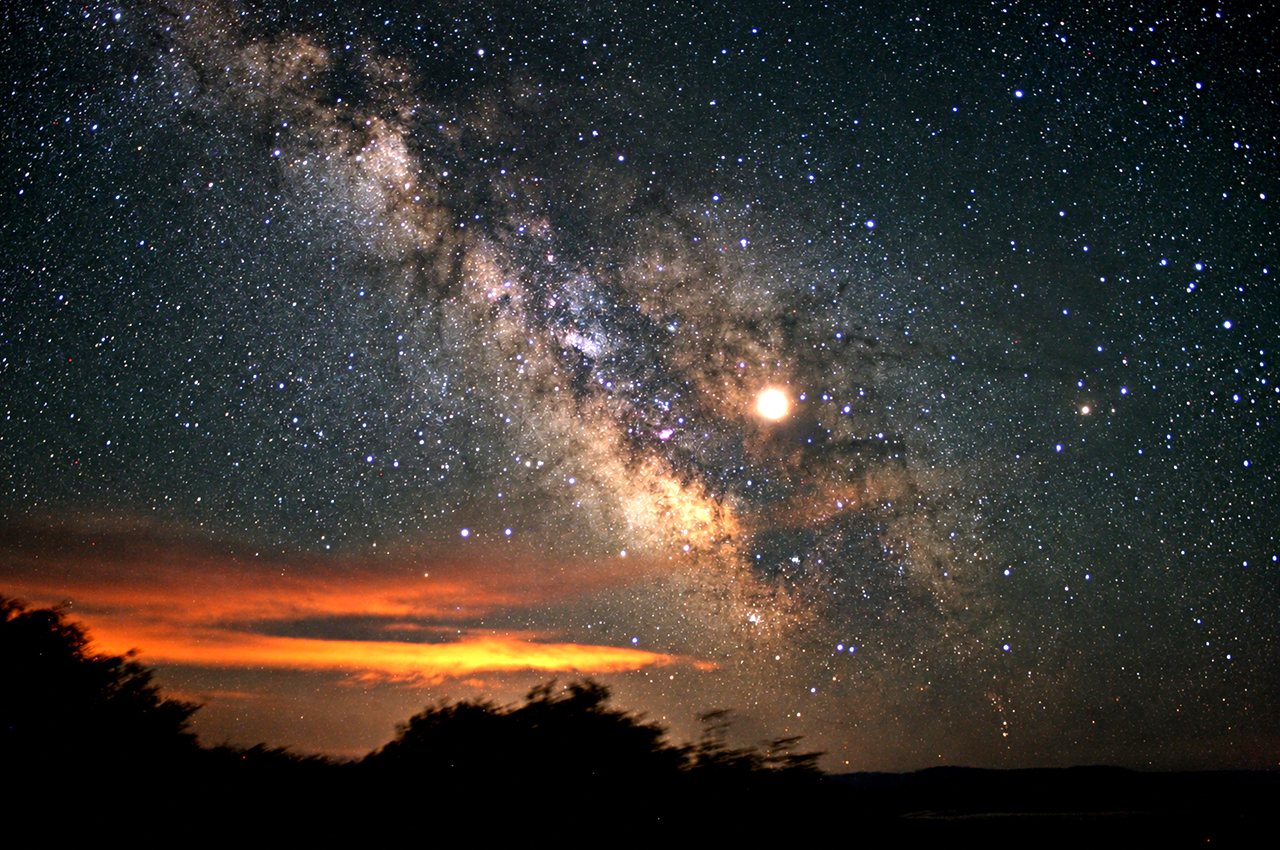
The sky tonight · Surrey
What's in the night sky over Surrey tonight?
Tuesday, 6 October 2026. Sunset at 6:28 pm, first stars by 7:40 pm. This evening Saturn is up; the Moon is a waning crescent, 17% lit.
This evening
Darkness, Moon and planets.
Darkness
Sunset 6:28 pm. The first stars show by 7:40 pm, and the sky is fully dark from 8:19 pm.
The Moon
Waning crescent, 17% lit, rises 3:07 am, sets 4:57 pm. The Moon stays out of the evening sky: a good night for star clusters, nebulae and the Milky Way.
Planets this evening
Saturn is up between sunset and 1 am.
Times are for Newlands Corner Car Park in the Surrey Hills, near Guildford, in UK time. Anywhere in Surrey, Berkshire, Hampshire or West Sussex they differ by only a few minutes. Worked out at 7:11 pm; reload the page on another day for that evening.
Where to look
Planets between sunset and 1 am.
Saturn
Up from 7:48 pm until after 1 am; highest in our evening around 12:48 am, 41° above the S horizon.
In the telescope: the rings, standing clear of the globe, and its largest moon Titan.
Uranustelescope only
Up from 9:38 pm until after 1 am; highest in our evening around 12:58 am, 42° above the ESE horizon.
In the telescope: a tiny pale blue-green disc, about 2.9 billion km away.
Neptunetelescope only
Up from 7:18 pm until after 1 am; highest in our evening around 12:08 am, 39° above the S horizon.
In the telescope: a faint blue star-like point at the edge of the solar system.
Not in the evening sky tonight: Mercury, Venus, Mars, Jupiter. Before dawn (around 6:12 am): Mars in the SE, 49° up; Jupiter in the ESE, 36° up.
Coming up
Dates worth knowing.
- Tue 6 Oct — Saturn was at opposition on Sun 4 Oct — still at its best, up most of the night
- Thu 8 Oct — Draconids meteor shower peak (best after midnight, away from the Moon)
- Sat 10 Oct — New Moon — darkest nights of the month around this date
- Sun 18 Oct — First quarter Moon — craters at their best in the evening
- Wed 21 Oct — Orionids meteor shower peak (best after midnight, away from the Moon)
- Mon 26 Oct — Full Moon
- Mon 9 Nov — New Moon — darkest nights of the month around this date
- Tue 17 Nov — First quarter Moon — craters at their best in the evening
- Tue 17 Nov — Leonids meteor shower peak (best after midnight, away from the Moon)
- Thu 11 Feb 2027 — Jupiter at opposition — closest and brightest, up all night
- Fri 19 Feb 2027 — Mars at opposition — closest and brightest, up all night
Best nights for the telescope
The planets and the Moon are fine on almost any clear night. Faint things — star clusters, nebulae, galaxies, the Milky Way — need the Moon out of the way: the week around the new Moon is best.
See it for yourself
On our evenings the 12-inch telescope shows the Moon's craters, Saturn's rings and Jupiter's moons live. Check the sky map for any date and time, then pick a night on the weather calendar.
Questions people ask
Can I see the planets without a telescope?
Yes — Venus, Jupiter, Saturn and Mars look like bright stars that don't twinkle much. A telescope turns them into worlds: Saturn's rings, Jupiter's belts and moons.
What time does it get dark tonight?
Sunset is at 6:28 pm. By 7:40 pm the brighter stars are out, and from 8:19 pm the sky is as dark as it gets.
Where can I see the stars near Guildford?
Anywhere high and open, away from street lights — the North Downs around Newlands Corner is one of the closest. See stargazing near Guildford.
Plan an evening
or call / text +44 7404 933156 Alex